
Interoperability Reference Architecture
Connecting research tools through a shared blueprint.
A practical guide to help different tools and services in research work together smoothly using common formats, standards, and connections.
A framework that helps research tools, like DMPs platforms, SKGs, and FAIR assessment tools, communicate and work together. It defines how these systems connect, what kind of information they exchange, and where standardisation helps ensure they speak the same language.
Developers, service providers, research infrastructure managers, and policy makers aiming to improve how research platforms interact and exchange data — within institutions and across borders.
Research tools often operate in silos. This makes it hard to reuse data, track results, or automate workflows. The Reference Architecture removes these barriers by offering a clear, standards-based approach to integration. It ensures flexibility, avoids vendor lock-in, and helps institutions future-proof their systems.

The architecture builds on the OSTrails PTA (Plan-Track-Assess) Pathways and, at its core, introduces three distinct yet complementary interoperability frameworks (IFs): DMP-IF, SKG-IF, and FAIR-IF. Each framework has been developed using established community standards, while remaining adaptable to the evolving needs of researchers, institutions, and service providers.
- DMP-IF: Supports dynamic, machine-actionable (ma) DMPs by enabling real-time updates via shared APIs. For example, when a dataset is published, the system can automatically update the relevant DMP. It builds on the RDA DMP Common Standard, enriched with an application profile tailored to funder and community needs.
- SKG-IF: Facilitates consistent, structured metadata exchange through Scientific Knowledge Graphs. It improves and extends the current RDA SKG-IF Core Data Model with scientific domain-specific instruments and software services using a new mechanism. A dedicated API supports rich querying, semantic filtering, and relationship-based discovery of research outputs.
- FAIR-IF: Aligns and makes transparent FAIR assessments by standardising how test results are described and shared. Built on DCAT and DQV standards, it introduces a common output model and API structure, enabling tools to compare results and integrate assessment data into other workflows.
- Research Outputs
Deliverable 1.4: OSTrails Interoperability Reference Architecture V1
Introduces the OSTrails reference architecture and three Interoperability Frameworks for DMPs, SKGs, and FAIR Assessment. It outlines interactions between components, clarifying standardised methods while allowing flexible implementation.
Deliverable 1.5: OSTrails Interoperability Reference Architecture V2
Coming Soon
- Other Useful Sources & Documentation
It is a metadata application profile to provide basic interoperability between systems producing or consuming machine-actionable data management plans (maDMPS).
Introduces the Scientific/Scholarly Knowledge Graph Interoperability Framework (SKG-IF). It outlines its motivation, relation to key elements, and applications in OSTrails.
OSTrails Commons
Shared resources to achieve interoperability and federation within the EOSC ecosystem.
A collection of open, reusable resources that enable platforms and services to align with OSTrails' Interoperability Frameworks and Reference Architecture, fostering integration and collaboration across research infrastructures.
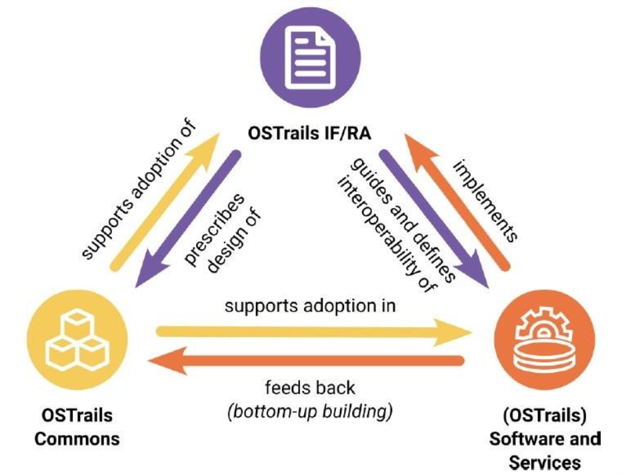
The OSTrails Commons is a set of shared building blocks, such as specifications, guidelines, and support assets, that support the adoption of interoperable, EOSC-aligned research tools and services. It is a foundational resource designed to help tools integrate within a common ecosystem.
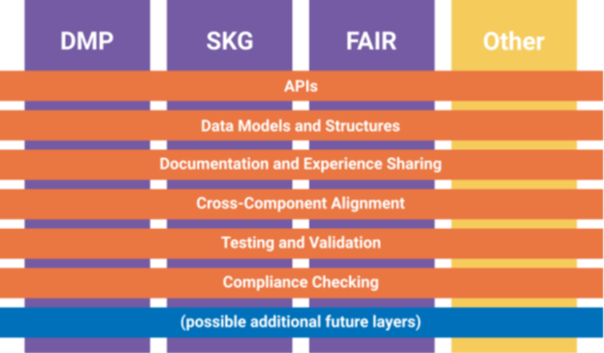
The Commons supports developers, infrastructure providers, research institutions, and service operators seeking to align with European and global standards for Open Science interoperability.
By lowering technical and conceptual entry barriers, the Commons enables seamless interaction between tools like DMP platforms, SKGs, and FAIR assessment tools. It fosters coherence, reuse, and sustainability across the research landscape.
- Provides standardised specifications aligned with the OSTrails Interoperability Framework and Reference Architecture.
- Offers a flexible structure for integrating new and existing tools.
- Aligns with international models such as the RDA Global Open Research Commons (GORC), ensuring global applicability.
- Includes a roadmap to guide future development and implementation.
- Research Outputs
Deliverable 2.5: OSTrails Commons Specifications
The document defines the first iteration of the OSTrails Commons, a set of open specifications to integrate DMP platforms, SKGs, FAIR assessment tools, and other services. It specifies the core concepts, features, and structure of the Commons, aligning with European and global standards to ensure scalability and interoperability.
- Other Useful Sources & Documentation
OSTrails Commons Documentation
The OSTrails Commons is a structured collection of open, reusable specifications designed to facilitate interoperability within the OSTrails ecosystem. Its governance ensures sustainable management, adoption, and evolution. The governance framework incorporates structured leadership, participation policies, and sustainability strategies aligned with global best practices, including the Global Open Research Commons (GORC).
Milstone 6: FAIR Assessment Commons
Software Release