

The portuguese OSTrails pilot was present at the Dataverse Community Meeting 2026 in Barcelona, presenting “FAIR Assessment and DataRepositóriUM: OSTrails pilot use case”, both as a poster and as a presentation. The contribution was part of the panel “Showcase: FAIR data publication, curation, and assessment”.
About the Dataverse Community Meeting
The Dataverse Community Meeting(DCM) is an international event that brings together repository managers, developers, researchers, and data professionals working with the Dataverse platform and related research data infrastructures. It provides a space to share experiences, showcase developments, and discuss approaches to data publication, curation, and FAIR alignment.
From FAIR Principles to Practice: The OSTrails FAIR Reference Model
The aim of this presentation was to introduce the core of the OSTrails FAIR Reference Model (FRM) and demonstrate its practical application through the use case of DataRepositóriUM - University of Minho Data Repository, showcasing how the model can be used to assess the FAIR compliance of datasets deposited in repositories. The presentation illustrated how the FRM approach can serve as an example for other repositories seeking alignment with the FAIR principles.
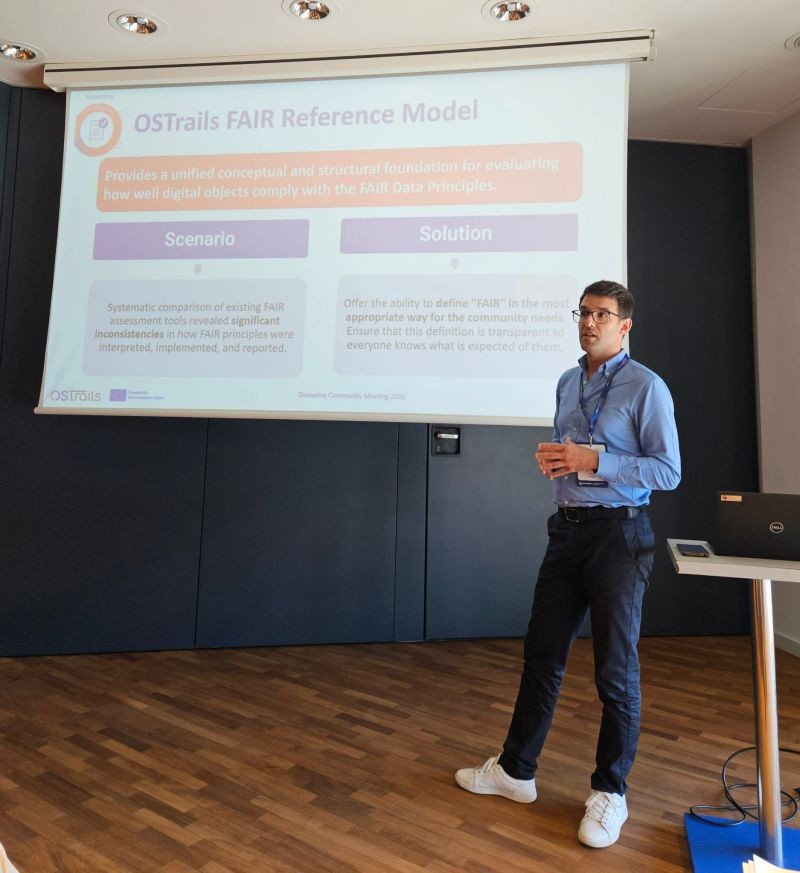
This work reflects the ongoing collaboration between the University of Minho and FCCN-FCT (digital services of Foundation for Science and Technology) within the Portuguese pilot, focusing on the practical implementation of FAIR assessment in institutional data repositories.
A pilot tailored to the specific needs of Portuguese Dataverse repositories
The Portuguese OSTrails pilot aims to design and implement a FAIR benchmark specifically adapted to the characteristics of the Portuguese Dataverse repositoryneeds, . This initiative recognises that generic FAIR assessment frameworks do not always fully capture the operational context and specificities of institutional repositories.
By grounding FAIR assessment in a real-world repository environment, this pilot contributes to making evaluation approaches more practical, actionable, and relevant for repository managers.
The OSTrails FAIR Reference Model
The FAIR Reference Model enables a unified conceptual and structural foundation for evaluating how well datasets comply with the principles of being Findable, Accessible, Interoperable, and Reusable. Developed within the OSTrails project, the model emerged from a systematic comparison of existing FAIR assessment tools, which revealed significant inconsistencies in how FAIR principles were interpreted, implemented, and reported. To overcome this fragmentation, the FRM identifies the core components essential for FAIR assessment (Dimensions, Metrics, Tests, and Benchmarks) and defines how these components should be represented, related, and expressed through machine‑actionable metadata.
The FRM plays a key role in improving the FAIR assessment of datasets deposited in repositories by establishing a shared vocabulary and conceptual structure. It enables harmonised and transparent evaluations, reducing discrepancies that arise when different tools assess the same object using divergent interpretations of FAIR principles.
Relevance of the FAIR Reference Model and Portuguese FAIR Benchmark for the Dataverse Community
The presentation of the FRM, together with the Portuguese FAIR Benchmark, provided an important opportunity to disseminate one of the key contributions of OSTrails to a broader community of data repository managers worldwide.
By engaging with the Dataverse community, this work supports ongoing efforts to establish a shared foundation for assessing the FAIRness of digital objects, while recognising the need to adapt evaluation approaches to the specific contexts and requirements of different communities. The discussion fostered interest in how such a benchmark can be applied in practice, contributing to more consistent, transparent, and community-driven FAIR assessment practices.
Access to materials:
The presentation and poster are available here: https://hdl.handle.net/1822/101486


