

The OSTrails project successfully hosted a workshop at IDCC 2026 in Zagreb with over 30 participants and lively discussion. Bringing together researchers, developers, and research data management (RDM) experts explored interoperable approaches to managing and sharing research data.
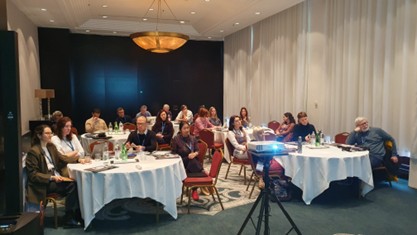
The workshop was delivered with contributions from key OSTrails members, including Tomasz Miksa (TU Wien), Diamantis Tziotzios (CITE), Jakub Jirka (CODE), Andrea Mannocci (CNR), and Esteban Gonzalez (Universidad Politécnica de Madrid) alongside other project collaborators.
The workshop also provided an opportunity to engage with Croatian pilot partners our Croatian pilot partners in person Ivana Končić, Bojan Macan, and Alen Vodopijevec.
The workshop aimed to showcase the OSTrails Pathways and Interoperability Frameworks as key mechanisms for validating results and extending the project beyond its three pillars.
Feedback
There is a strong interest in the OSTrails vision, particularly in its potential to connect Data Management Plans (DMPs), Semantic Knowledge Graphs (SKGs), and FAIR assessment workflows into a more cohesive and interoperable ecosystem. Additionally, Electronic Lab Notebooks (ELNs) and data notebooks have been identified as key integration points for future development, highlighting the importance of creating seamless links between data creation, management, and evaluation processes.
Key Focus
The OSTrails Commons was a central point of discussion, highlighting its role in enabling communities to both contribute to and adopt shared solutions beyond the scope of the project for example by enabling communities to reuse and adapt interoperability components such as FAIR-IF and DMP-IF. The workshop also emphasized the importance of moving from technical frameworks toward real-world implementation, with the goal of simplifying research data management (RDM) practices for researchers.
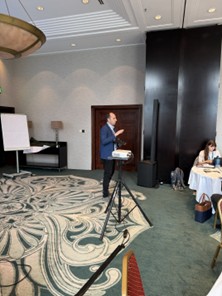
Interactive World Café discussions provided space for participants which encouraged cross-disciplinary exchange and highlighted practical implementation challenges.
The main challenges identified were:
- The need for clearer, community-aligned FAIR definitions to support automated evaluation
- The need for better insights into how SKGs and DMPs can be integrated across workflows
- The challenges of managing large data volumes across disciplines
Impressions
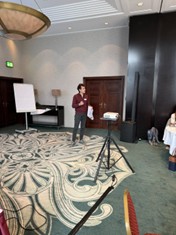
Overall, feedback was very positive, with participants offering suggestions to further improve communication of project outputs and strengthen integration between FAIR and DMP evaluation workflows. These insights will inform the next phase of OSTrails development and support broader adoption across research communities.
The workshop successfully met its objectives to showcase project achievements, promote adoption, gather community feedback, and explore future directions—reinforcing OSTrails’ role in advancing interoperable and researcher-focused RDM solutions.


