FAIR Assessment in Data Repositories: Showcase of the Portuguese OSTrails pilot

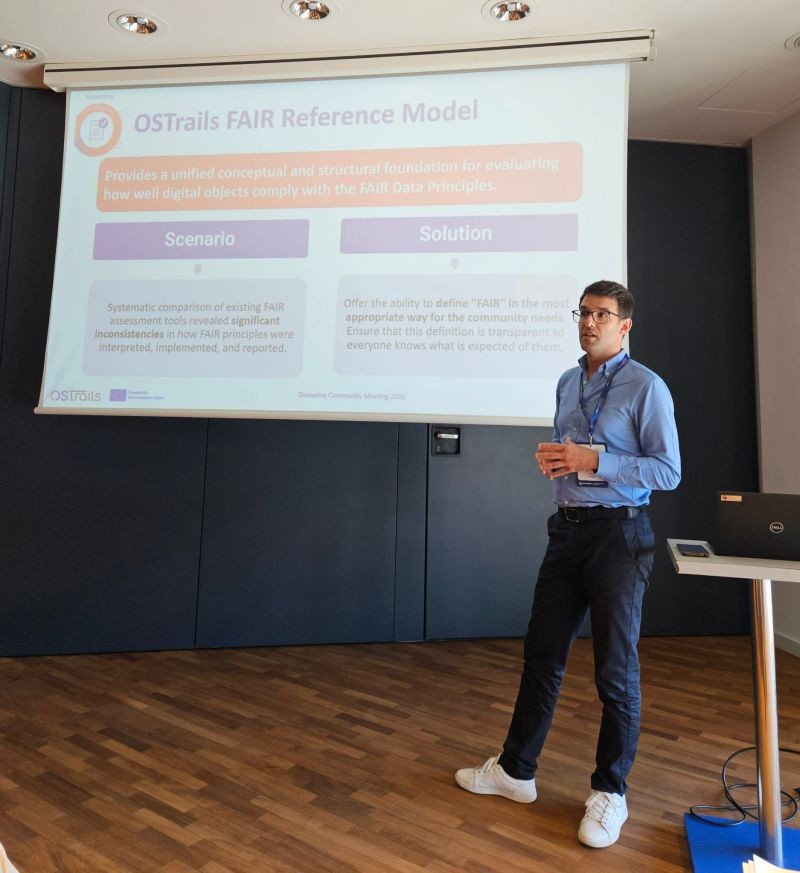
The portuguese OSTrails pilot was present at the Dataverse Community Meeting 2026 in Barcelona, presenting “FAIR Assessment and DataRepositóriUMOSTrails pilot use case”, both as a poster and as a presentation. The contribution was part of the panel Showcase: FAIR data publication, curation, and assessment”.

About the Dataverse Community Meeting

The Dataverse Community Meeting(DCM) is an international event that brings together repository managers, developers, researchers, and data professionals working with the Dataverse platform and related research data infrastructures. It provides a space to share experiences, showcase developments, and discuss approaches to data publication, curation, and FAIR alignment.

From FAIR Principles to Practice: The OSTrails FAIR Reference Model

The aim of this presentation was to introduce the core of the OSTrails FAIR Reference Model (FRM) and demonstrate its practical application through the use case of DataRepositóriUM - University of Minho Data Repository, showcasing how the model can be used to assess the FAIR compliance of datasets deposited in repositories. The presentation illustrated how the FRM approach can serve as an example for other repositories seeking alignment with the FAIR principles.

1778835562826 1

This work reflects the ongoing collaboration between the University of Minho and FCCN-FCT (digital services of Foundation for Science and Technology) within the Portuguese pilot, focusing on the practical implementation of FAIR assessment in institutional data repositories.

A pilot tailored to the specific needs of Portuguese Dataverse repositories

The Portuguese OSTrails pilot aims to design and implement a FAIR benchmark specifically adapted to the characteristics of the Portuguese Dataverse repositoryneeds. This initiative recognises that generic FAIR assessment frameworks do not always fully capture the operational context and specificities of institutional repositories.

By grounding FAIR assessment in a real-world repository environment, this pilot contributes to making evaluation approaches more practical, actionable, and relevant for repository managers.

The OSTrails FAIR Reference Model

The FAIR Reference Model enables a unified conceptual and structural foundation for evaluating how well datasets comply with the principles of being Findable, Accessible, Interoperable, and Reusable. Developed within the OSTrails project, the model emerged from a systematic comparison of existing FAIR assessment tools, which revealed significant inconsistencies in how FAIR principles were interpreted, implemented, and reported. To overcome this fragmentation, the FRM identifies the core components essential for FAIR assessment (Dimensions, Metrics, Tests, and Benchmarks) and defines how these components should be represented, related, and expressed through machineactionable metadata. 

The FRM plays a key role in improving the FAIR assessment of datasets deposited in repositories by establishing a shared vocabulary and conceptual structure. It enables harmonised and transparent evaluations, reducing discrepancies that arise when different tools assess the same object using divergent interpretations of FAIR principles.

Relevance of the FAIR Reference Model and Portuguese FAIR Benchmark for the Dataverse Community

The presentation of the FRM, together with the Portuguese FAIR Benchmarkprovided an important opportunity to disseminate one of the key contributions of OSTrails to a broader community of data repository managers worldwide.

By engaging with the Dataverse community, this work supports ongoing efforts to establish a shared foundation for assessing the FAIRness of digital objects, while recognising the need to adapt evaluation approaches to the specific contexts and requirements of different communities. The discussion fostered interest in how such a benchmark can be applied in practice, contributing to more consistent, transparent, and community-driven FAIR assessment practices.

Access to materials:

The presentation and poster are available here: https://hdl.handle.net/1822/101486

  • Created on .
  • Last updated on .
  • Hits: 63

The call for applications for participation in the 2nd OSTrails Train-the-Trainer Bootcamp is open!

We are pleased to announce the second edition of the OSTrails  Train-the-trainer Bootcamp, to be held online September 22-24.  

The event offers training on the three OSTrails pillars - Data Management Plans, Scientific Knowledge Graphs, and FAIR Assessment. It aims to provide participants with the opportunity to work directly with the teams developing the OSTrails tools and services, while gaining a practical understanding of implementation requirements, integration workflows and training approaches. 

The bootcamp is meant for OSTrails pilots, trainers, IT infrastructures managers, research support staff and data stewards from national infrastructures and research iInfrastructures (recruited from relevant competence centres and training initiatives of the European Research Area and ESFRI RIs). 

Participation in the bootcamp is free of charge but requires prior registration. Applications will be evaluated based on the information provided in the registration form, including motivation, expected impact, and future plans for applying the knowledge gained during the training.

Participants are expected to have some prior knowledge of the main OSTrails topics and to plan training activities on these topics within their communities.

The first edition of this bootcamp, held in March 2026, was exclusively aimed at OSTrails pilots. This second edition, however, is open to the wider community. You can explore the main outcomes of the first edition in this news item.

Registrations close on 3 July 2026.

Applicants will be notified by 13 July 2026 whether their application has been accepted. 

Application form: https://forms.office.com/e/PnfH5VL0LB  

  • Created on .
  • Last updated on .
  • Hits: 520

OSTrails General Assembly: All hands-on deck for the last year

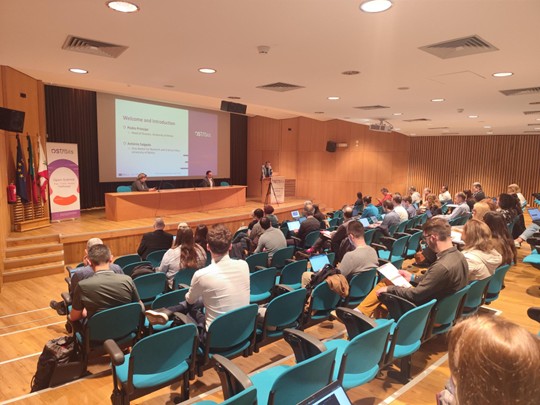
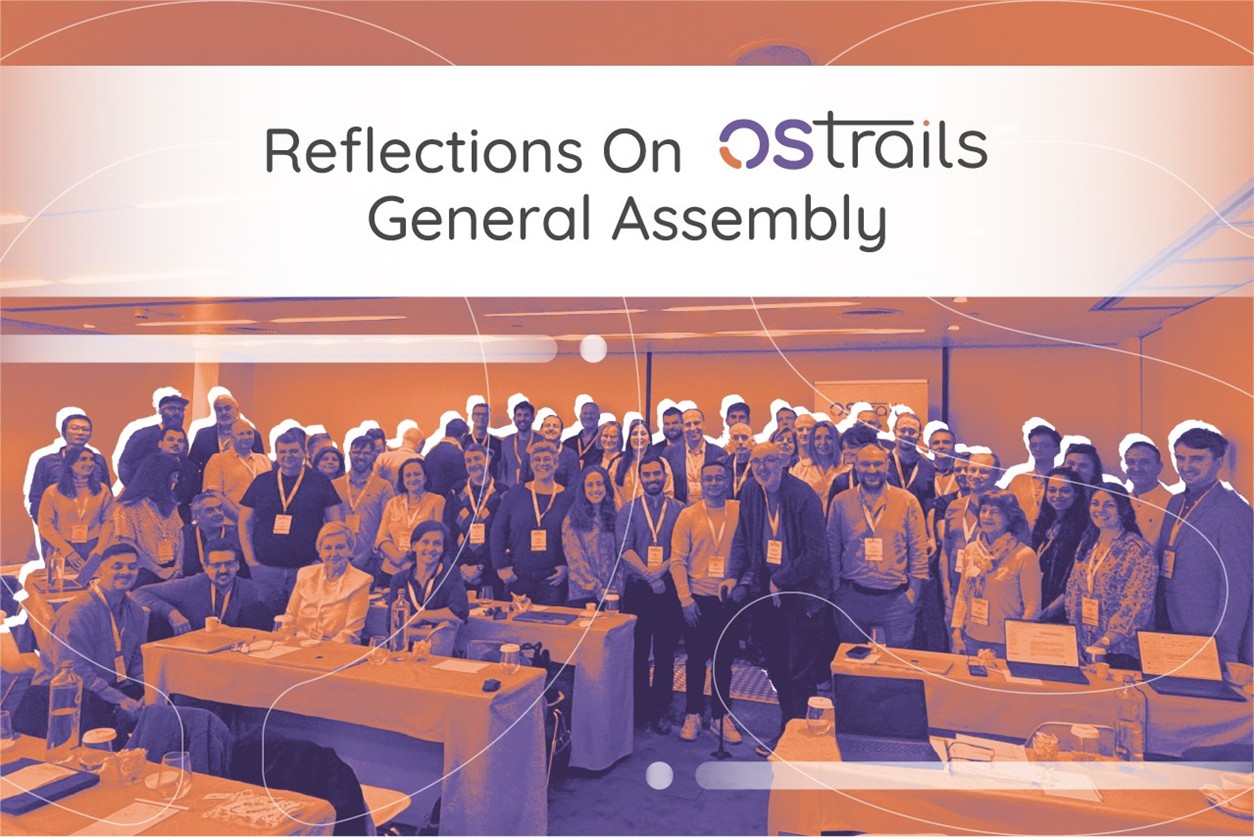
The OSTrails consortium held its General Assembly on 23-24 March in Braga, bringing together partners to review progress and align on the next phase of the project. The meeting marked a clear transition from framework development towards initial implementation across pilots

Discussions covered project results, pilot activities, technical readiness and capacity-building efforts, all framed within the broader objective of supporting interoperable and FAIR research practices across Europe.

Key Outcomes

The meeting confirmed that OSTrails is delivering tangible results that are actively used by the 41 partner organisations, highlighting the real-world impact, usefulness, and value of the outputs generated. The emphasis is now on supporting pilots in adopting and integrating the project’s outputs within their communities, ensuring that these are tested, validated, and effectively used in their diverse settings.
2

A strong position of the project at the European Open Science Cloud (EOSC) Federation was also highlighted during the discussions. OSTrails interoperability frameworks are already being adopted by several EOSC Nodes (e.g. PaNOSC, CSC – IT Center for Science Ltd) as important components for enabling Federation capabilities for planning, tracking and assessing knowledge production. In this context, long-term sustainability remains a key priority, with continued development and consolidation of OSTrails Commons, and the importance of governance approaches supported by community endorsement.

Year 2 has delivered a substantial set of results across the project’s core areas. In the FAIR domain, the project has developed and released multiple frameworks and services, supported by FAIR metrics and the publication of FAIR-related resources on platforms such as GitHub. Seven services have already adopted FAIR-IF components, with five partners actively using DCAT application profiles and one external platform having migrated to the framework.

In the DMP, work has progressed on machine-actionable Data Management Plans, including the development of application profiles, APIs, and alignment with RDA Common Standards. For scientific knowledge graphs, SKG-IF has been implemented across multiple infrastructures, including APIs and extensions. A validation and tagging framework have also been introduced, supported by an open-source graph-agnostic tool and a proposed registry of norms with persistent identifiers.

The project has also demonstrated strong outreach impact, reaching multiple stakeholders across Europe and beyond, with project outputs widely accessed through Zenodo.

A Look Back: What We Discussed
  • PTA Pathways & Interoperability Reference Architecture

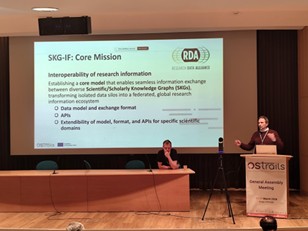
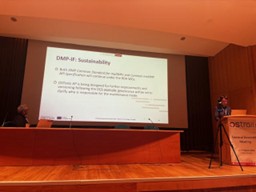
Participants emphasised that while the Findable, Accessible, Interoperable, Reusable – Interoperability Framework (FAIR-IF), Data Management Plan – Interoperability Framework (DMP-IF), and Scientific Knowledge Graph – Interoperability Framework (SKG-IF) are now well-developed, their real value will depend on how easily they can be applied in practice. Improving usability and providing clearer, more concrete guidance for pilot implementations were identified as essential next steps to ensure these frameworks effectively support reuse, standardisation, and system integration.
  5

Building on this, discussions focused on advancing interoperability through concrete implementation efforts across pilots and services, where integration is already underway to combine FAIR assessment, machine-actionable DMPs, and SKG technologies into operational workflows. For example, DMP tools are being connected via APIs to enable automated creation and updating of plans, FAIR assessment services are being embedded into metadata harvesting pipelines, and SKG components are being used to link datasets, publications, and services within research infrastructures.

Several concrete tools and services were highlighted throughout the sessions. These include FAIRassist, used for the creation and discovery of FAIR metrics and benchmarks, FAIR Champion, which currently include two registered tests that serve as the first validation tools, and the broader FAIR metrics ecosystem, which now comprises 85 active metrics. In the DMP domain, tools such as DSW and ARGOS are being updated to support the DMP Common Standards, including API-based workflows and integration of the DMP Evaluator as a service. For scientific knowledge graphs, infrastructures such as ROHub, OpenAIRE, CESSDA, CLARIN, and OpenCitations are already implementing SKG-IF components and APIs.

At the same time, these discussions highlighted opportunities to further strengthen the solutions being developed. Ongoing efforts are focusing on enhancing usability, improving metadata quality through more robust harvesting and validation approaches, and refining how technical concepts are translated into clear, user-facing guidance, key steps to support broader adoption and more effective use across diverse research communities.
4

  • Pilot Progress

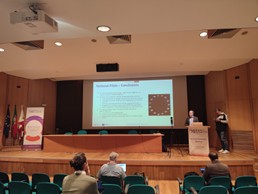
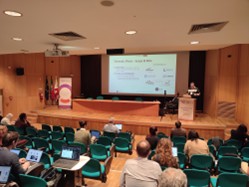
National pilots, such as those in Poland, Finland, Spain, and Sweden, are focusing on large-scale coordination across institutions, repositories, CRIS systems, and national infrastructures. For instance, the Spanish pilot now aggregates metadata from 191 repositories and has implemented validation mechanisms and controlled vocabularies for DMP, resulting in nationwide DMP publication coverage. The Finnish pilot is developing a national maDMP template designed to be applicable across approximately 60 organisations.

In parallel, thematic pilots, including Marine and Coastal Science, Social Sciences and Humanities, and Astronomy, are integrating OSTrails components directly into disciplinary workflows. These include the use of SKG editors, DMP APIs, FAIR assessment tools, and knowledge graph infrastructures to support research processes, metadata enrichment, and data publication pipelines.
7 8

Capacity Building

Capacity building is a central component of OSTrails, designed to support adoption, knowledge transfer, and long-term sustainability of project results (https://ostrails.eu/training).

The project is to develop a structured set of activities that include a training library, online courses, factsheets, a train-the-trainer bootcamp, and a mentorship programme. The training library serves as a central repository for reusable materials, while online courses focus on practical topics such as DMPs and machine-actionable workflows. Additional materials will be produced including how-to guides that provide structured and targeted information on how to use the OSTrails software, tools and services.

Immediately following the meeting, OSTrails delivered its first Train-the-Trainer Bootcamp on 25 March in Braga, marking an important step as the project moves into its implementation phase. The Bootcamp focused on equipping organisations, trainers, and pilot partners to act as multipliers, supporting wider adoption of OSTrails results.

Across all these activities, sustainability is a key consideration. Materials are being made available through existing infrastructures to ensure that capacity-building efforts are practical, accessible, and aligned with the needs of pilots and stakeholders.

Conclusions

The General Assembly confirmed that OSTrails is now firmly in its implementation phase, with strong foundations in place across FAIR, DMP, and SKG interoperability frameworks. The immediate focus is on supporting pilot implementations while advancing upcoming deliverables and milestones.

Work will continue implementing APIs and strengthening interoperability, alongside hands-on support for pilots adopting OSTrails tools and services. Ensuring that these solutions are practical, well-documented, and effectively integrated into real-world environments will be a shared priority across partners.

Capacity-building efforts will expand through training courses, bootcamps, and supporting materials, helping communities adopt and apply the project’s outputs. At the same time, attention to user support and long-term sustainability will remain central to maximising impact.

By aligning technical development with community engagement and structured support, OSTrails is well positioned to contribute to a more interoperable and FAIR-aligned research ecosystem.

The General Assembly also provided a valuable opportunity for partners to meet in person, exchange ideas, and strengthen collaboration across the consortium. Bringing the team together reinforces the shared commitment to the project’s goals and supports the collective effort to promote OSTrails solutions and maximise their impact across the research ecosystem.

1

  • Created on .
  • Last updated on .
  • Hits: 523

Launching the OSTrails Train‑the‑Trainer Bootcamp: Empowering trainers to make research tools work together at scale

OSTrails organised its first Train-the-Trainer Bootcamp on 25 March in Braga, following a successful two-day General AssemblyThe Bootcamp marked a key step as the project moves into its implementation phase, focusing on equipping organisations, trainers, and pilot partners to act as multipliers for the adoption of OSTrails results.

The session brought together technical experts, trainers, and pilot representatives in a highly interactive setting. Participants engaged directly with the teams developing OSTrails tools and services, gaining a practical understanding of implementation requirementsintegration workflows, and training approaches.

Pilots and trainers worked closely with participants through group sessions and hands-on activities to explain the OSTrails reference architecture and interoperability frameworks, outline requirements for using the services, and demonstrate their practical application. These sessions fostered strong knowledge exchange and supported participants in preparing their own training activities.

IMG 20260325 100104

Core OSTrails results and tools in practice

The bootcamp focused on translating OSTrails concepts into concrete implementation practices.

Through hands-on sessions and group work, participants:

  • Explored the OSTrails reference architecture and interoperability frameworks 
  • Learned how to adopt services within institutional and national infrastructures 
  • Tested real integration scenarios across tools and systems 
  • Prepared to deliver their own training activities 

Across the different tools presented, a clear convergence is emerging: the focus is not on the tools themselves, but on their ability to implement shared, interoperable approaches. This enables information to move across systems, while keeping DMPs flexible and strengthening their role in structured evaluation and guidance on shared topics.

Learning from pilot implementations

The programme continued with a usecase implementation session, allowing pilot partners to share progress on their pilots’ activities and engage with the technical staff to clarify questions. This exchange created space for practical discussions on how to apply OSTrails specifications in real settings, helping participants better understand how to move forward in their own contexts.

imagem 17

The discussion highlighted the diversity of pilot approaches and levels of maturity.

  • Some national initiatives, such as those in Finland and Portugal, are building strong community engagement around shared DMP application profiles.
  • Others, including Croatia and Greece, are working closely with funders to align implementations with national policies and requirements.
  • At the same time, thematic infrastructures such as CESSDA and LifeWatch are focusing on improving and connecting domain services to support discovery and enhance the FAIRness of data.

Pilots also shared practical challenges encountered during implementation, such as staff turnover, and dependencies between tasks. These experiences underlined the need for flexibility and continuous coordination. At the same time, the discussions highlighted the importance of trust-based collaboration with national research support services and expert communities: Open dialogue, shared experiences, and ongoing outreach efforts were seen as essential for building momentum and supporting the broader adoption of interoperable solutions across DMPs, FAIR assessment, and research information systems. 

Training Stationsworking directly with tools and services

The bootcamp also included interactive training stations, designed to give participants direct access to the tools and services behind OSTrails. 

Pilot partners and technical experts were positioned across dedicated stations, where participants could move between them, ask questions, and discuss their specific implementation needs. There were 7 stations covering key areas, such as FAIR assessment and validation, FAIR benchmarks and metrics, machine-actionable DMPs, DMP evaluation, and Scientific Knowledge Graphs.

Planning for local trainings

At the end of the bootcamp, pilots were challenged to develop and present their own training plans covering webinars, workshops, and hands-on sessions, tailored to different audiences, including researchers, data stewards, and service providers.

20260325 110344

A strong emphasis was placed on reusing and adapting training materials to fit local needs, while enabling participants to act as multipliers within their organisationsThis marked a shift from learning to active rollout, with pilots preparing concrete activities to be delivered across the consortium over the coming year. Planning for the second edition of the Train-the-Trainers Bootcamp will begin soon.

All training materials, resources, and updates will be made available at the following link: Bootcamps - OSTrails

  • Created on .
  • Last updated on .
  • Hits: 822

OSTrails Workshop at IDCC 2026 Highlights Progress in Interoperability Frameworks

The OSTrails project successfully hosted a workshop at IDCC 2026 in Zagreb with over 30 participants and lively discussion. Bringing together researchers, developers, and research data management (RDM) experts explored interoperable approaches to managing and sharing research data.

Picture1idcc

The workshop was delivered with contributions from key OSTrails members, including Tomasz Miksa (TU Wien), Diamantis Tziotzios (CITE), Jakub Jirka (CODE), Andrea Mannocci (CNR), and Esteban Gonzalez (Universidad Politécnica de Madrid) alongside other project collaborators.

The workshop also provided an opportunity to engage with Croatian pilot partners our Croatian pilot partners in person Ivana Končić, Bojan Macan, and Alen Vodopijevec.

The workshop aimed to showcase the OSTrails Pathways and Interoperability Frameworks as key mechanisms for validating results and extending the project beyond its three pillars.

Feedback

There is a strong interest in the OSTrails vision, particularly in its potential to connect Data Management Plans (DMPs), Semantic Knowledge Graphs (SKGs), and FAIR assessment workflows into a more cohesive and interoperable ecosystem. Additionally, Electronic Lab Notebooks (ELNs) and data notebooks have been identified as key integration points for future development, highlighting the importance of creating seamless links between data creation, management, and evaluation processes.

Key Focus

The OSTrails Commons was a central point of discussion, highlighting its role in enabling communities to both contribute to and adopt shared solutions beyond the scope of the project for example by enabling communities to reuse and adapt interoperability components such as FAIR-IF and DMP-IF. The workshop also emphasized the importance of moving from technical frameworks toward real-world implementation, with the goal of simplifying research data management (RDM) practices for researchers.

Picture3idcc

Interactive World Café discussions provided space for participants which encouraged cross-disciplinary exchange and highlighted practical implementation challenges.

The main challenges identified were:

  • The need for clearer, community-aligned FAIR definitions to support automated evaluation
  • The need for better insights into how SKGs and DMPs can be integrated across workflows
  • The challenges of managing large data volumes across disciplines

Picture4idcc

Impressions

Overall, feedback was very positive, with participants offering suggestions to further improve communication of project outputs and strengthen integration between FAIR and DMP evaluation workflows. These insights will inform the next phase of OSTrails development and support broader adoption across research communities.

The workshop successfully met its objectives to showcase project achievements, promote adoption, gather community feedback, and explore future directions—reinforcing OSTrails’ role in advancing interoperable and researcher-focused RDM solutions.

  • Created on .
  • Last updated on .
  • Hits: 528